“Our work was not simply about planting trees. It was about inspiring people to take charge of their environment, the system that governed them, their lives and their future.” -Wangari Maathai


“Our work was not simply about planting trees. It was about inspiring people to take charge of their environment, the system that governed them, their lives and their future.” -Wangari Maathai
You could use this book in any elementary grade level classroom to discuss the importance we play in our environment. You could also emphasize the sense of community in this book and how everyone has a role to play.
 pick
pickPublished in 2008, a biography. The story of Wangari Maathai, a nature loving woman who founded the Green Belt Movement in her home country after returning to barren land after college. She involved all pieces of her community to work together and plant trees to bring her home country land of Kenya back to life.

“The ocean is a system, and understanding it and keeping it healthy is vital for both sharks and us.”

This book could be used in the classroom to engage students in nonfiction texts, as many young readers are interested in sharks. This could be used in a science unit on ecosystems and animal adaptations.

 so-so
so-soPublished in 2014, a nonfiction book. Katherine Roy uses vivid language and watercolor illustrations to explain the lives of great white sharks. She introduces topics like hunting and anatomy. This book is well-suited for upper elementary readers, especially those interested in ocean life.
“It‘s scary to break the rules, but sometimes you have to if you want to find out what‘s really out there”
This book could be used in a classroom for social-emotional learning. There are various themes of friendship, empathy, courage, and freedom.
pickPublished in 2000, speculative fiction. What if the dolls on your shelf were alive and they had their own secret world when you weren‘t looking? This book brings you into an old dollhouse that gains a new doll family and a mystery must be solved.
“‘I just need you to do this one thing for me, Drew.‘ Heidi was as bad a mother dead as she was alive. And I was just as much a sucker.”
You could use this book to spur conversations about real-life issues students could be facing like family brokenness, financial stress, and/or self identity and purpose.
pickPublished in 2023, a young adult contemporary fiction book. This book follows a responsible teenage girl who is left to care for her younger siblings after the disappearance of their mother.
You could use this book to begin an exploration of Mexican culture. Reading this book could also foster discussions about feelings of anxiety and loss.
pickGraphic Novel, published in 2016. This book explores the idea of taking risks for those you love. It brings readers into the minds of the characters and how they‘re feeling about their forced move to a new place.
“Once upon a time, there was a little girl named Elisabeth who lived with her mother in a house on the edge of a village.”
You could use this book in the classroom to introduce or practice sequencing and retelling.
pickTraditional literature, published in 1983. A fairy tale about a girl‘s journey delivering food to her sick grandmother and what she encounters along the way.
You could use this book to begin a discussion on loyalty in friendship.
pickPicture Book, published in 2010
The illustrator uses color and composition throughout the book to draw attention to specific details.
This book could be used in a lower elementary classroom that enjoys singing short rhyming songs. There is also a lot of metaphorical language throughout this book that could be used during figurative language work.
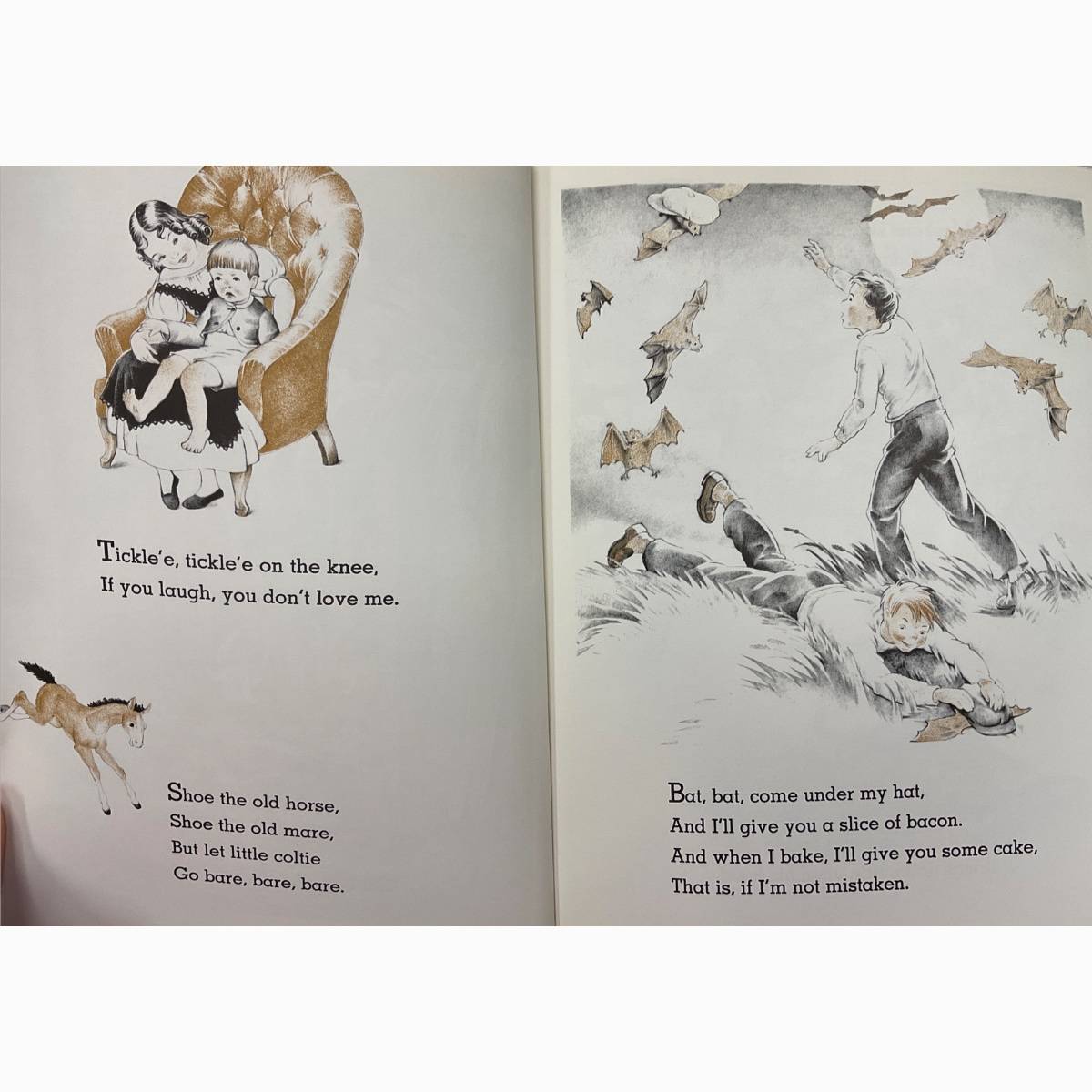
pickPicture Book, published in 1945
The illustrators of this book use both a technique of composition and color. They provide illustrations as aides to remember the rhymes and jingles while also following a color theme by page.
You could use this book to begin exploring the family traditions of students in the class.
pickPicture Book, published in 1993
The illustrator of this book uses composition, arranging flying objects on the page surrounding a car to portray that the driver is in a hurry because they are excited to visit their family.
This book could be used to begin a discussion or activity on the students expressing themselves and finding their identity.
pickPicture Book, published in 2013
The illustrator uses fonts and text size to represent the loudness and feelings of the main character. The text exploding outside the borders of the text bubble resembles him venturing out of the metaphorical box he‘s been put in by other animals in his community.
“Never had there been such a feast. Never had the peasants tasted such soup. And fancy, made from stones!”
This book could be used in the beginning of the school year to encourage students that each have things to offer in a classroom community.
pickPicture Book, published in 1947
The illustrator of this book uses many curvy lines that portray all characters being contributing and involvement in making the soup.
“By the end of the week, Jasper was seeing creepy carrots creeping EVERYWHERE.”
You could use this book in a classroom to practice making predictions because there is a lot of hinting and anticipation methods used in this book. It is also a great book for they fall/Halloween time.
pickPicture Book, published in 2012
This book uses dark and light illustrations to create a “creepy” feeling for readers. The illustrator also uses shapes to display the main characters mind.
You could use this book in a classroom to begin a discussion about cultural differences, specifically food culture.
pickPicture Book, published in 2024
This book uses a contrast of colors that correlate with contrasting feelings. Darker blues and greys portray sadness and loneliness at the main characters new school while the brighter oranges and pinks portray warm feelings when reminded of home.
“You‘re not going to interrupt the story are you?”
This would be a great book to use for fluency practice. It uses humorous dialogue to help build expressive reading and comprehension.
pickPublished in 2010, Caldecott Honor. A hilarious and charming story about a chicken who just can‘t help but interrupt during bedtime stories.
“Chooch learns by watching, and you are one of his most important teachers.”
This book can be used to foster classroom community and even when and/or if declaring and reflecting on classroom jobs.
pickPublished in 2024, Caldecott Honor. A short story about a young boy who bravely tries to help his family how he knows how. It encourages the importance of giving and accepting help from others.
This book could be used as a social studies connection to teach about Indigenous Cultures, environmental justice, and the real-life events at Standing Rock.
pickPublished in 2020, Caldecott Honor. A powerful and poetic tribute to Indigenous peoples‘ connection to nature and their role in protecting the Earth. Inspired by the Indigenous-led protests against the Dakota Access Pipeline at Standing Rock in 2016.
“It was a stick — a stick that was just right for smacking a snow-covered tree.”
This book could be used to discuss the usage of color by illustrators to portray moods of story characters.